A ManyPlay browser walkthrough · Checked . Screenshots below show the actual game. Illustrated catalog covers are presentation artwork. Who publishes these games?
Checked local opening actions — no complete win or public-live release
Start here
Start with the seven columns, the stock at the upper left and the four foundations. Select Draw 1 or Draw 3 deliberately. A different variant can replace an unfinished deal after a confirmation. The illustrated guide follows checked local opening actions; it is not a public-live or complete-win example.
The rules you need
Build four foundations by suit, from Ace to King.
Build tableau sequences down in alternating colours. Only Kings can fill empty columns.
Only the top exposed waste card can be played, including in Draw 3.
Undo changes the position; Hint suggests a move; Check deal searches for a winning continuation.
An Ace move, Undo and the stock: three different decisions
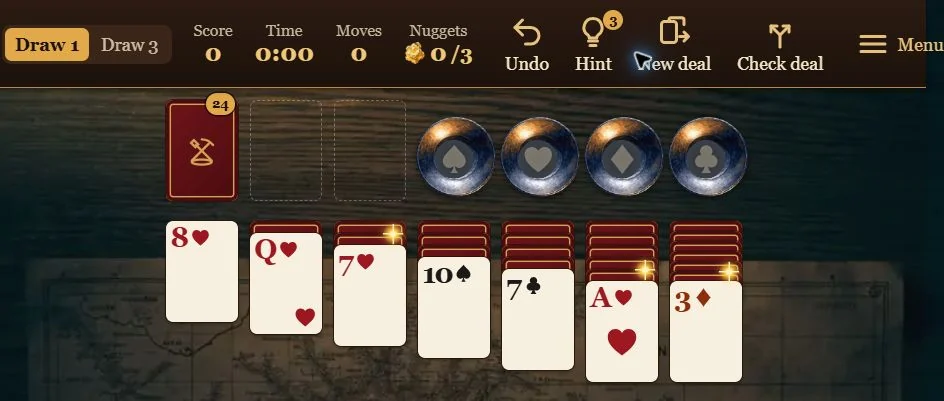
The Draw 1 opening showed stock 24, Score 0 and Moves 0. Sound and Music were turned off in Settings before gameplay. The exposed heart Ace supplied a simple move whose effect could be checked and then reversed. These screenshots show the actual local preview, not an artificially completed board.
Actual local Klondike preview: Draw 1, stock 24, Score 0 and Moves 0 before the checked Ace move
Move the exposed Ace
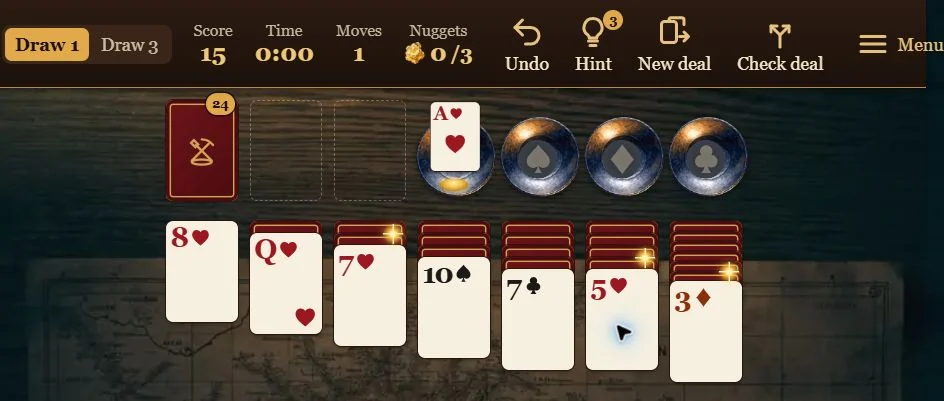
Clicking the face-up heart Ace moved it into its suit foundation and exposed the next tableau card. The visible counters became Score 15 and Moves 1. The 15 points include the effects of this opening action; this is not a general claim that every card move scores 15.
Move the exposed Ace — actual result
Use Undo to restore the position
Undo returned the opening card arrangement and restored Score 0/Moves 0. Elapsed time was not rewound. This is a useful way to compare a branch, rather than treating a screenshot of the later position as the original deal.
Keep Hint and Check deal separate
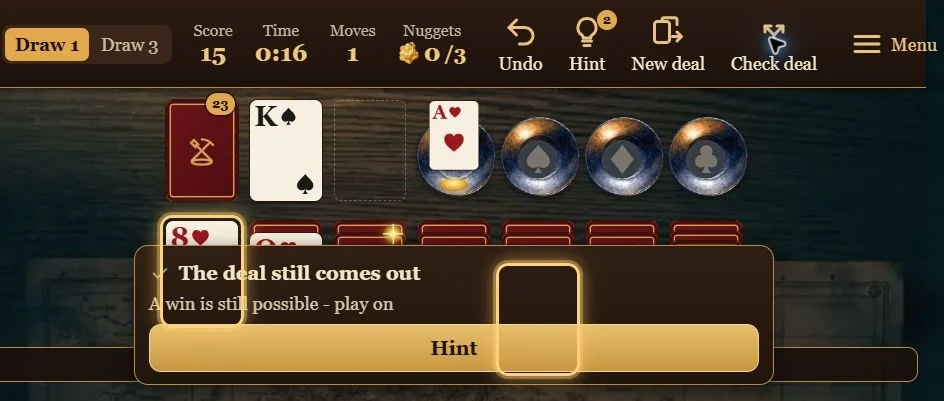
Hint changed the free allowance from 3 to 2. After a stock draw, Check deal reported that a win was still possible. That message establishes a solver result for the current position, not that the game has already been won.
Keep Hint and Check deal separate — actual result
Compare a separate Draw 3 deal
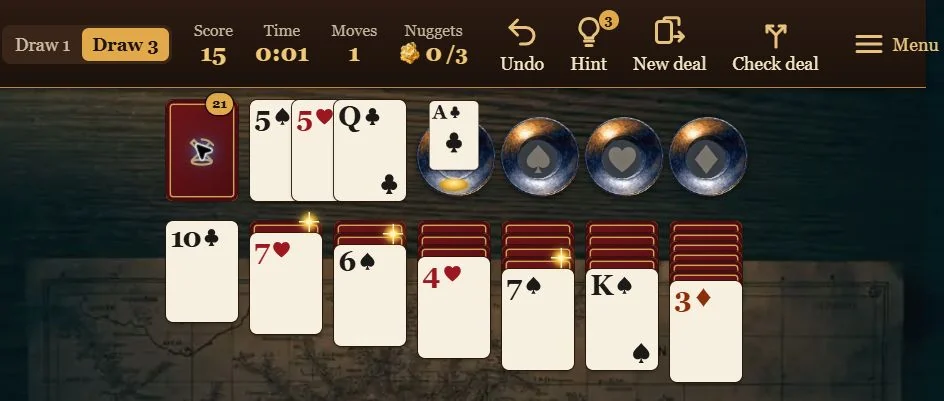
Changing the variant showed a confirmation that the old deal would count as played. Starting the new deal reset its counters. Clicking stock changed 24 to 21 and displayed three waste cards. Only the top one is available for a move. Reload kept Draw 3, stock 21, Score 15 and Moves 1; automatic foundation movement was enabled.
Compare a separate Draw 3 deal — actual result
What this example teaches
The opening Ace improved access to its column. Undo let us compare that change with the original arrangement. Draw 3 changed stock access in a different deal, while Check deal answered a different question from Hint. None of these observations establishes a full win or a measured win rate.
Mistakes to avoid
Do not try to play a covered waste card.
Do not fill a valuable empty column without considering the King or sequence it could receive.
Do not interpret an inconclusive check as a proven loss.
Do not confuse Klondike Draw 1/Draw 3 with Spider suit counts.
Questions about this board
What is the goal of Klondike Solitaire?
Move all 52 cards to the four foundations, one for each suit, building from Ace to King. On the tableau, build down in alternating colours. Only a King or a sequence beginning with a King can fill an empty column.
What changes between Draw 1 and Draw 3?
Draw 1 turns over one stock card. Draw 3 turns over three, but only the exposed top waste card can be played. Choosing a different variant asks before starting a new deal and replacing the unfinished layout.
Does Undo restore the score?
In the checked local example, moving the exposed heart Ace changed Score 0/Moves 0 to 15/1. Undo restored the position and those counters to 0/0. It did not rewind elapsed time.
Does Check deal solve the game for me?
It checks whether a winning continuation can be established from the current position. A positive result is not a completed game. An inconclusive result means the search did not establish an answer within its budget; it does not prove a loss.
Are hints unlimited?
A fresh deal supplies three free hints. In the local check the counter changed from 3 to 2. Do not rely on additional rewarded hints when advertising is unavailable.
Will my cards survive a reload?
The checked local browser preserved Draw 3, stock 21, score 15 and one move after a reload. This is evidence for that browser and origin, not a promise of cross-device saves. Clearing site data or starting another deal can replace progress.
Other modes and further play
Daily, large-card and language options are defined by the game. Daily depends on the server UTC date. A midnight rollover, actual physical phone, complete win, rewarded hints and the Fork failure-position flow are outside this checked example. The preview uses the ManyPlay test platform, where platform data can be reset; local browser saves are separate.
Report a changed rule or control. Browser and Android editions can differ; the checked date describes this walkthrough, not a new game release.
UNDERSTAND THE NEXT DECISION
Read the position before spending the next stock card
Klondike combines incomplete information with choices about access. You cannot see the face-down cards, but you can inspect the exposed cards, the top waste card and the columns that your move will free. The distinction between a legal placement and a useful change is the starting point for a careful game.
The tableau and foundations have different jobs
The tableau is a working area. Build descending sequences in alternating colours, such as a red 7 on a black 8. The four foundations collect a single suit in ascending order, beginning with its Ace. A card can fit one rule while being unavailable for the other.
An empty tableau column is not a free home for every card. It accepts a King or a descending sequence beginning with a King. Before using that space, consider which hidden card the move will expose and what other King may need the column later. The rules do not make every legal choice equally helpful.
Draw 3 changes access, not the foundation rules
In Draw 3, three stock cards turn onto the waste at once. Only the top exposed waste card can be played; you cannot select a lower card simply because its rank fits. This makes the order of access an additional constraint. The tableau and foundation rules stay the same.
The checked local Draw 3 deal went from stock 24 to21 after one stock action and showed three waste cards. It was a separate deal from the earlier Draw 1 opening, so the two screenshots are not consecutive positions in one continuous run. The game confirmed the replacement before starting that variant.
Use Undo, Hint and Check deal for their own purposes
Undo restores a previous position. In this example it also restored the displayed score and move count, while elapsed time continued. Hint consumed one of the three free allowances. That counter matters: there is no promise of endless free or rewarded advice.
Check deal asks whether a winning continuation can be established. The source uses a finite search budget. A positive result means a continuation was found, not that your current deal has already ended in victory. An inconclusive result means the search did not establish an answer; it is not a proof that no solution exists.
Return to the fork, then reconsider the move
In one checked local Draw 3 deal, ordinary manual play reached move 48. Check deal reported that the deal had stopped having a winning continuation after move 31, and offered Back to the fork. Choosing it restored move 30, Score 140 and one collected nugget; elapsed time continued. Checking again found a winning continuation from that restored position.
This is a concrete example of using the fork to revisit an earlier decision. It is not a completed win, and move 31 is not a rule for other deals. A legal card placement can change which cards remain accessible later. After returning, inspect the newly restored board and choose a different route instead of repeating the same move automatically.
Keep local saves and changing variants in mind
A normal reload retained the local Draw 3 position, stock count and counters in the checked browser. That is useful evidence for returning to this origin with its storage intact. It is not a guarantee of cross-device synchronisation, permanent account storage or survival after clearing site data.
The game warned that changing variant starts a new deal and counts the unfinished one as played. Read that confirmation rather than using the variant buttons as a harmless preview. The local test accepted the replacement for its own temporary deal; a player should make that choice deliberately.
Compare Klondike with Spider without mixing the settings
Klondike uses one deck, seven tableau columns and four Ace-to-King suit foundations. Spider uses two decks, ten columns and eight completed King-to-Ace sequences. Their similar card artwork does not make the rules interchangeable.
Draw 1 and Draw 3 describe Klondike stock access. One, two and four suits describe the Spider presets in this catalogue. If your question is about mixed-suit groups that cannot move together, the Spider guide is the relevant comparison.
Explanation checked 2026-10-30. Source1500b21; ordinary local Chrome move/Undo/Hint/Draw3/reload and actual Fork48→30→positive Check deal. Screenshots/readback: local-fork-loss,local-fork-return,local-fork-return-check. Physical-phone, full-win and public-live acceptance remain separate.