Start here
Choose Campaign and Level 1, the unlocked 5×5 map. Read the first-run tutorial: it asks you to make a dot, turn it into a feudal, and clear it before guiding the first claims. Complete those prompts before trying another cell.
Read the controls, follow the real example and compare the result before trying your own run.
Play Feudaly →A ManyPlay browser walkthrough · Checked . Screenshots below show the actual game; cover illustrations in the catalog are presentation artwork. Who publishes these games?
Verified opening-board solution
Choose Campaign and Level 1, the unlocked 5×5 map. Read the first-run tutorial: it asks you to make a dot, turn it into a feudal, and clear it before guiding the first claims. Complete those prompts before trying another cell.
Count rows from top to bottom and columns from left to right, starting at 1. In this map, the yellow land occupies only r1c4 and r1c5. The green land occupies r1c2, r1c3 and r2c3. The first-run tutorial highlights cells, but the deductions below explain their positions.
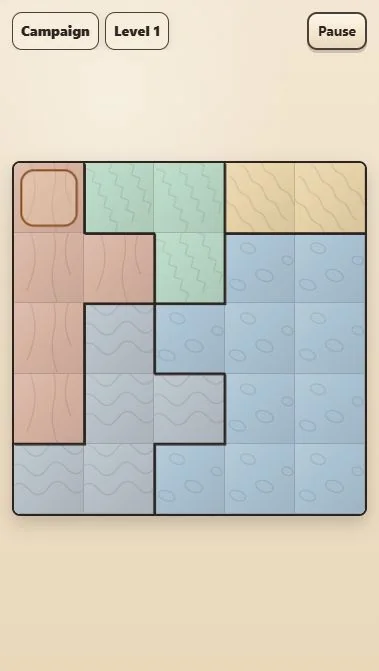
Yellow must occupy row 1. Green therefore cannot use either of its row-1 cells and must take r2c3. A row-1 piece in c4 would touch r2c3 diagonally, so yellow must take r1c5. The tutorial presents these claims in the opposite order; both constraints lead to the same pair.
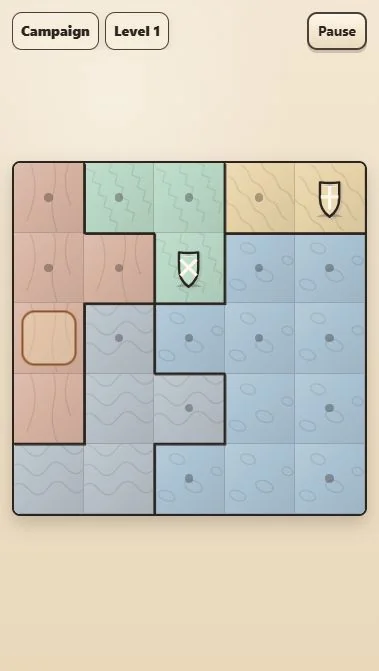
The piece in r2c3 excludes c2, c3 and c4 in row 3. Column 5 already belongs to r1c5. Place the third piece at r3c1, in the left-hand land.
The unused columns are 2 and 4. r4c2 would touch r3c1, so choose r4c4. The last piece is r5c2. Feudaly confirms Map Solved!; the finished rows use columns 5–3–1–4–2.
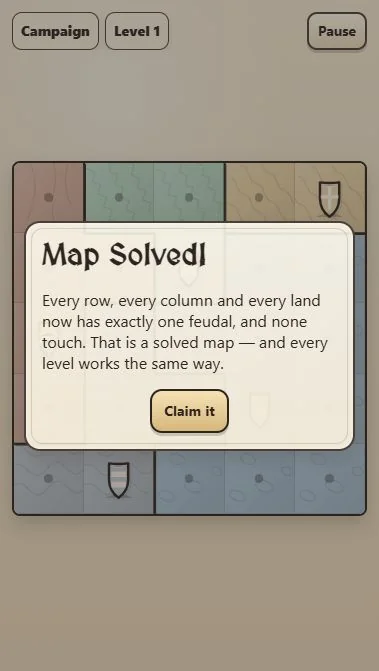
Each deduction removes choices using more than one rule. The final five pieces use all five rows, columns and lands exactly once. Consecutive rows differ by at least two columns, so no pair touches diagonally. Claim it dismisses the explanation and reveals the solved board.
Green is forced to r2c3 once row 1 is reserved for yellow. r1c4 touches that green piece diagonally, leaving r1c5 for yellow.
No. The game supplies automatic dots after a placement. Manual dots can preserve other deductions, but they are not a separate completion target.
Campaign selection lists map sizes and difficulty, including a 500-board catalog. That is a menu listing, not a claim that all 500 boards were completed here. Daily and Endless are also offered; this walkthrough covers the shown first map.
Report a changed rule or control. Browser and Android editions can differ; the checked date describes this walkthrough, not a new game release.