Mahjong solitaire rules in one sentence: remove pairs of the same free tile until the table is empty. Below is a real example from the browser game, then the full rules.
A ManyPlay browser walkthrough · Checked . Screenshots below show the actual game. Illustrated catalog covers are presentation artwork. Who publishes these games?
Verified opening-board solution
Start here
New to mahjong? Start on Easy. Your first deal shows a short lesson on the real table. After it, Pairs left shows how many pairs are still on the table and Pairs available how many you can remove right now. An unfinished deal is saved in this browser.
The rules you need
Clear the table by removing tiles in pairs of the same tile.
A tile is free when nothing lies on it and its left or right side is open; covered tiles are dimmed.
Tap a free tile, then the same free tile somewhere else, and the pair leaves the table.
Any flower matches any flower, and any season matches any season.
No pairs left? Shuffle lays the remaining tiles out again; Undo takes your last move back.
Worked example: remove a free pair, then ask for a hint
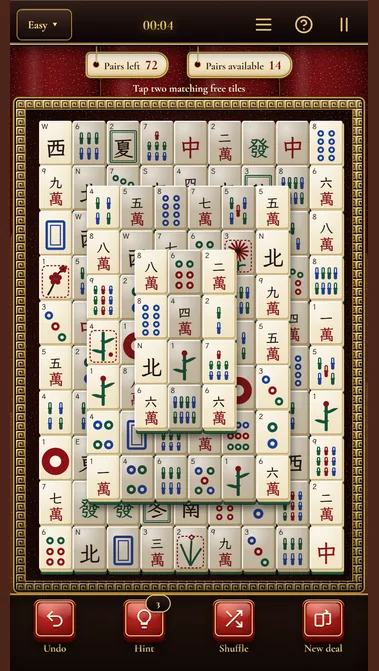
Here is a real Easy deal in the Pyramid layout. At the start the counters read Pairs left 72 and Pairs available 14. On the left of the upper layers, two 8 Characters tiles are free: nothing lies on them and one side of each is open.
Actual Easy deal in the Pyramid layout: Pairs left 72, Pairs available 14.
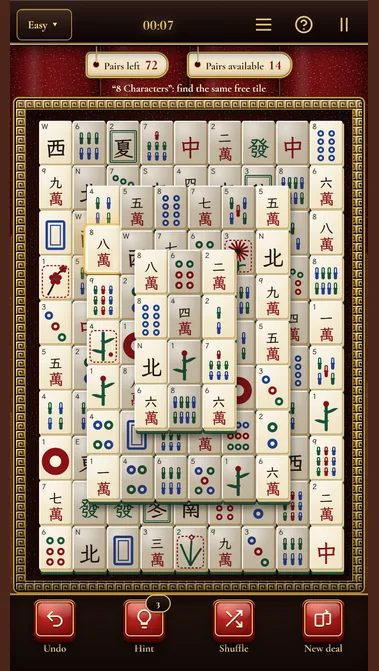
Tap the first tile
Tap one 8 Characters. The tile is ringed, and the line above the table says: “8 Characters”: find the same free tile.
Tap the first tile — actual result
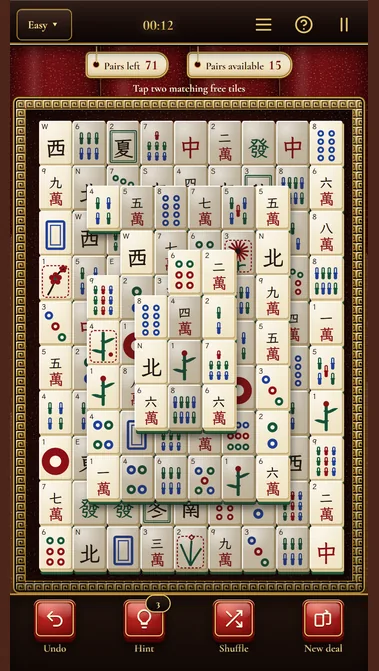
Tap its pair
Tap the other free 8 Characters. Both tiles leave the table: Pairs left drops from 72 to 71, and Pairs available rises from 14 to 15 — the tiles that lay under them can now be played.
Tap its pair — actual result
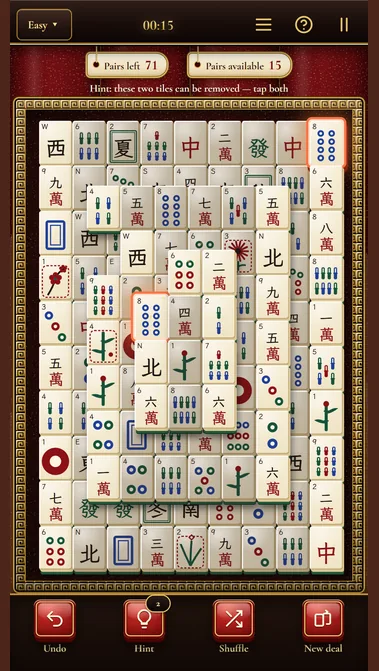
Ask for a hint
Press Hint. The game rings two tiles that can be removed — here two 8 Dots — and the line says: Hint: these two tiles can be removed — tap both. The badge on the Hint button drops from 3 to 2.
Ask for a hint — actual result
Why this sequence works
A pair from the top of a stack opens the tiles below it, so the number of moves you have grows instead of shrinking. That is the heart of mahjong solitaire strategy: when you have a choice, take the pair that frees other tiles.
Mistakes to avoid
Tapping a dimmed tile does nothing: it is covered, or both its sides are blocked. The line above the table tells you why it cannot go yet.
Taking any pair you see can lock tiles under each other. Look at what a pair uncovers before you take it, and keep Undo for a choice that goes wrong.
Questions about this board
Which tiles can I remove?
Only free tiles. A tile is free when no tile lies on top of it, even partly, and when its left side or its right side is open. Covered tiles are dimmed. If you tap one anyway, the line above the table tells you why it cannot be removed yet.
Is every game winnable?
Yes. Every deal is built solvable: the game lays the tiles so that a way to clear the table exists. Your own moves can still lead into a dead end; then you can shuffle the remaining tiles or undo a move and try another pair.
What happens when there are no moves left?
The game tells you that no pairs are left and offers two ways on: Shuffle lays the remaining tiles out again so that pairs open up, and Undo takes your last move back. If no shuffle can help, you can undo moves or start a new deal.
Other modes and further play
The menu also has Medium and Hard deals, the layout of the day, the Lantern Trail of eighteen layouts and a two-player duel. This example checks one Easy deal in the browser build, not every layout or mode.
Report a changed rule or control. Browser and Android editions can differ; the checked date describes this walkthrough, not a new game release.
UNDERSTAND THE NEXT DECISION
Mahjong solitaire rules in detail
Mahjong solitaire is a calm puzzle for one player. It uses the tiles of mahjong, but it is not the four-player game with draws, discards and winning hands that people play in Hong Kong, China or Japan. Here you are alone with a table of stacked tiles, and your only task is to clear it. This guide explains how to play mahjong solitaire from the first tap to the last pair, and what every button and number on the screen means.
The tiles
A deal uses 144 tiles. There are three suits with numbers from 1 to 9: Dots (circles), Bamboo (sticks) and Characters (a Chinese numeral above the sign for ten thousand). Each of those 27 tiles is in the set four times. Then come the honour tiles, also four of each: the four winds - East, South, West and North - and the three dragons - red, green and white. Finally there are eight special tiles: four flowers (plum, orchid, chrysanthemum and bamboo) and four seasons (spring, summer, autumn and winter). Every flower and every season is in the set only once.
A small index in the corner of each tile helps when the symbols are new to you: the number of a suit tile, or the first letter of a wind - E, S, W or N.
The layout
The tiles are laid out in a layout of several layers, like a small building: a wide floor, smaller floors on top and sometimes a single tile on the very top. Upper tiles are shifted a little up and to the left, so you can see the edges of the floors below. Each deal uses one of many layouts - a pyramid, a flower, a fortress, a cactus and others.
The one rule: remove free pairs
You remove the tiles two at a time, as a pair of the same tile: two 5 of Dots, two East winds, two green dragons. You can only take a free tile. A tile is free when two things are true at once:
- nothing lies on it, not even a part of a tile from the floor above; - its left side or its right side is open - there is no tile right next to it on that side.
A tile with neighbours on both sides is closed, even if nothing lies on it. A tile under another tile is closed, even if both its sides are open. Covered and closed tiles are dimmed, so you can see at once which tiles you may take. If you tap a closed tile anyway, it shakes and the line above the table says why: a tile lies on it, or both of its sides are closed.
Flowers and seasons are the friendly exception. Any flower matches any other flower, and any season matches any other season. A plum and an orchid make a pair; spring and winter make a pair too. A flower never matches a season.
Taking a pair
Tap a free tile - it lifts and gets a blue ring. Then tap the same free tile anywhere on the table. The pair leaves the table as a small paper lantern and the tiles under it may become free. If you tap a different tile instead, the selection simply moves to that tile. Tap the selected tile again, or the empty table, to drop the selection.
The numbers above the table
Two tags hang above the table. Pairs left is the number of pairs still on the table - the tiles on the table divided by two. Pairs available is the number of pairs you could remove right now. Watch this second number: when it falls to one, your next move decides a lot; when it is zero, you are stuck.
When you are stuck
Sometimes no two free tiles match. The game tells you so and offers two ways on. Shuffle lays the remaining tiles out again on the same places, so that new pairs open up. Undo takes your last move back, and you can undo again and again to the start of the deal. Every deal is built solvable: when the game deals the tiles, it makes sure that a way to clear the table exists. A dead end comes from the order of your own moves, never from a deal that cannot be won. In the rare case that no shuffle can help, the game says so, and you can undo or start a new deal.
Hints
Hint rings two tiles that you can remove now. Three hints are free in every deal; the small number on the Hint button shows how many are left. In a dead end the hint is free and points you to the shuffle. On your very first deal, if you wait a few seconds without moving, the game shows a pair by itself and does not spend a hint.
Levels
There are three levels. Easy deals keep several pairs open at every step, so you can learn the rules without pressure. Medium deals are the classic game. Hard deals are built along a narrow path: often only one or two pairs keep the way open, and the order of your moves matters.
The layout of the day, the Lantern Trail and the duel
The layout of the day is one deal for everyone, new every day; solving it on days in a row builds a streak. The Lantern Trail is a path of eighteen lanterns through layouts from easy to hard: win on the open lantern to light it, and the next one opens; a win without hints and shuffles makes the lantern gold. The duel is for two players on one screen: you take turns, each pair counts for the player who took it, a wrong pair passes the turn, and whoever removes more pairs wins.
Time, pause and statistics
The clock runs while you play and stops when you pause, open the menu or leave the page. Your progress stays on your device: reload the page and the deal continues where you left it. Statistics show the deals you started and solved, your best and average time on each level, the deals you solved clean and your win streak.
That is all you need to know to play mahjong solitaire. Start with an easy deal, take the pairs that free other tiles first, and keep an eye on Pairs available.
Explanation checked 2026-11-06. Studio rules guide docs/page/content/guides/en.rules.txt (spec 04, written to the game spec), checked against the build 5b6fc14 and its launch.js/app.js; counters and hint confirmed in the browser 2026-11-06