What one suit changes
In a one-suit game, a 9 placed on a 10 makes a group whose suits already match. That group can move together if a legal destination is available. You do not have to dismantle it later simply to separate hearts from spades.
One suit removes one obstacle, not every decision.
Touch · Mouse
Landscape game
All 104 cards are spades, so any descending sequence is automatically same-suit. You can focus on exposing hidden cards, finding useful empty columns and deciding when to spend a stock deal.
In a one-suit game, a 9 placed on a 10 makes a group whose suits already match. That group can move together if a legal destination is available. You do not have to dismantle it later simply to separate hearts from spades.
One suit does not reveal the face-down cards or guarantee a solvable layout. A legal move can fill a column you wanted to keep available, and a stock deal can cover exposed cards with new ones. Read the consequences before changing the board.
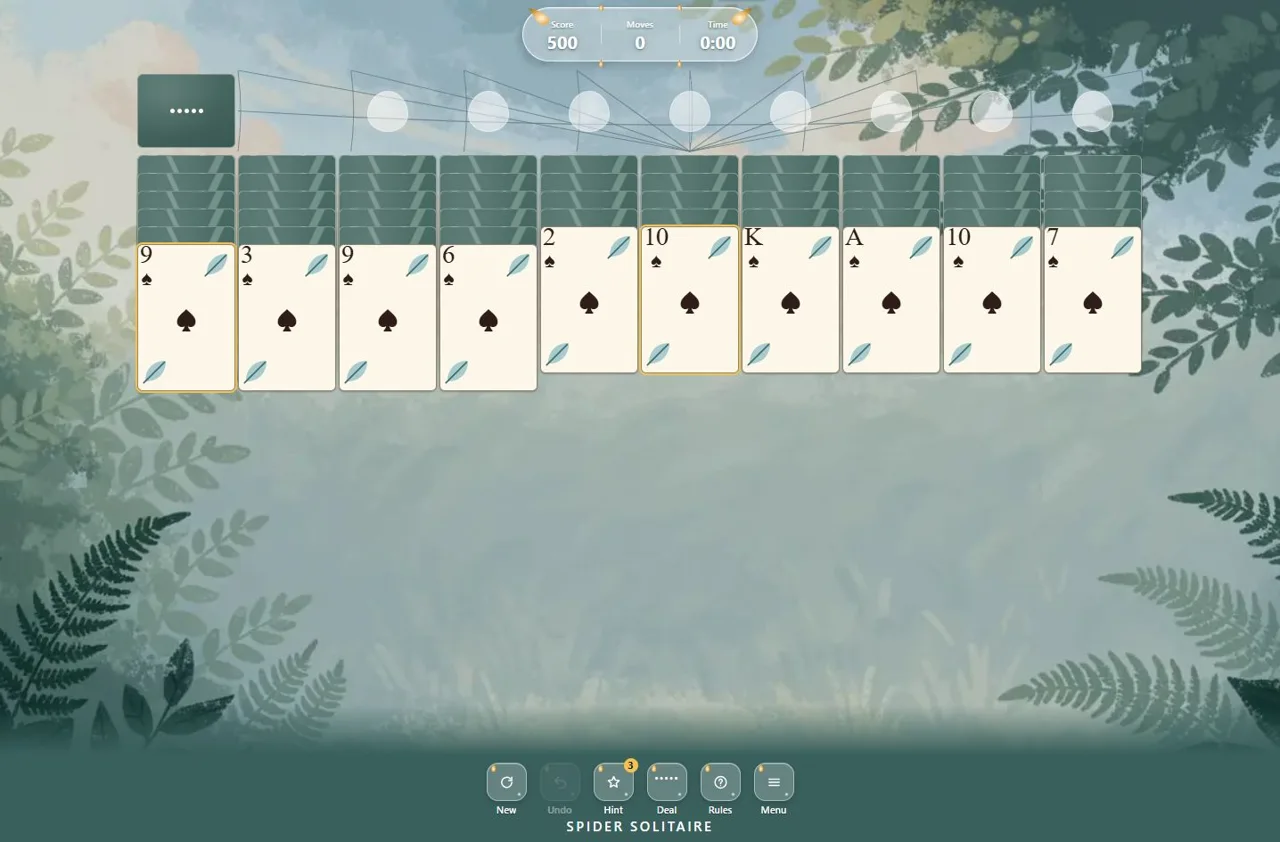
In the recorded one-suit example, moving a 9 of spades onto a 10 exposed a Jack. Score changed from 500 to 499 and Moves from 0 to 1. Undo restored the cards but changed those counters to 498 and 2. This illustrates how movement and scoring work; it does not solve the different random board you may receive in this mode.
The mode link starts the requested suit setting. The game stores one active deal: returning to the same suit count can resume it, but choosing a different suit count starts a new deal and replaces that unfinished layout. Statistics are kept by suit count. Keep the same browser and its site data for local progress.
Build eight complete sequences from King down to Ace in one suit. A complete sequence is removed automatically. The stock holds five rows of ten cards, and you must fill any empty column before dealing.
There are three free hints per deal. A hint is advice about the current position, not a proof that the deal can be completed. Undo is unlimited in uses, but every use costs one point. Read the full rules before relying on a score comparison across different deals.
Play Spider Solitaire with 104 cards across ten columns. Uncover hidden cards, keep same-suit runs movable and clear eight complete King-to-Ace sequences.
Choose Spider Solitaire for arranging descending card runs and uncovering hidden cards. The number of suits changes which groups stay movable.
The checked one-suit opening showed a 9 of spades in the first column and a 10 of spades in the sixth. Score was 500 and Moves was 0. A different deal can start with different cards.
Play in your browser. No app download is needed.
Click or tap a face-up card for an available automatic move, or drag it to a legal destination. A single card can go on any suit one rank higher. A group moves together only if its cards descend in the same suit.
Each stock deal adds one card to all ten columns. Fill every empty column before dealing, and check that a stock deal remains. There are five stock deals in a fresh game.
Undo has no use limit, but each undo costs one point and increases the action counter. In the checked example, a move changed Score 500/Moves 0 to 499/1; Undo restored the cards but changed the displays to 498/2.
The checked browser restored the cards, score, move count and timer after reload in the same suit mode. The game keeps one active deal; changing suit count starts another deal and replaces the unfinished layout. Clearing site data or using another browser can lose the local save. Cross-device cloud saves are not promised.
No solvability guarantee is provided. These pages demonstrate legal opening moves and Undo, not a complete win or a measured human win rate.
Original ManyPlay game. Controls and examples were checked against the browser edition; cover illustrations are labelled separately from gameplay captures. Report a changed rule or control.